
Loading...
Skip to main content

Like many websites, BSA’s websites use cookies to ensure the efficient functioning of those websites and give our users the best possible experience. You can learn more about how we use cookies, and how you can change your browser's cookie settings, in our cookies statement. By continuing to use this site without changing your cookie settings, you consent to our use of cookies.

X

Law Enforcement / Govt Access to Data

FEATURED POLICY RESEARCH / POSITION PAPERS

US: What is the Cloud Act?

US: What Is the Cloud Act?

AUG 19, 2025 | GLOBAL

The Clarifying Lawful Overseas Use of Data (CLOUD) Act amended the Electronic Communications Privacy Act (ECPA), which is the US statute governing how law enforcement agencies may obtain information held by certain technology companies, including cloud service providers. 

READ MORE
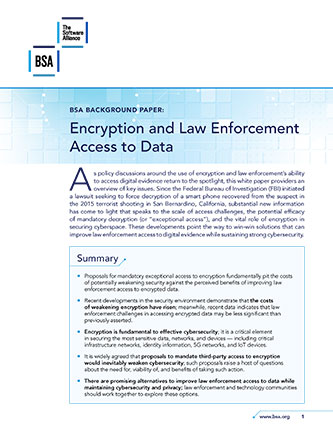
Encryption and Law Enforcement Access to Data cover

US: Encryption and Law Enforcement Access to Data

OCT 03, 2019 | US

As policy discussions around the use of encryption and law enforcement’s ability to access digital evidence return to the spotlight, this white paper providers an overview of key issues.

READ MORE
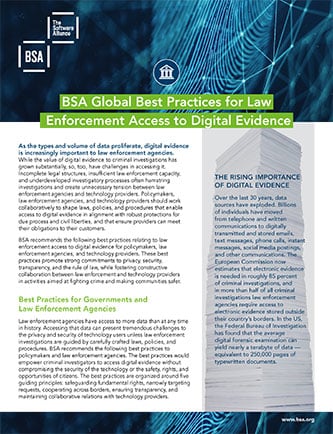
Global Best Practices for Law Enforcement Access to Digital Evidence cover

Global Best Practices for Law Enforcement Access to Digital Evidence

SEP 23, 2019 | GLOBAL

BSA recommends global best practices relating to law enforcement access to digital evidence that promote strong commitments to privacy, security, transparency, and the rule of law, while fostering constructive collaboration between governments, law enforcement agencies, and technology providers.

READ MORE

BSA FILINGS AND RESOURCES

Policy issues
Posted date
See all

THE LATEST POLICY NEWS

SEP 12, 2025 | EUROPEAN UNION | EUROPE, MIDDLE EAST AND AFRICA

The Business Software Alliance (BSA) calls for a proportionate and balanced approach to EU data retention. A future framework, BSA stresses in its response to the EU's consultation on data retention, should be limited to basic subscriber and traffic data already processed by electronic communication service providers – for investigating serious crimes only – with harmonized definitions. It should not create excessive regulatory burdens for service providers. Read more

See all